

Updated on August 4, 2011
You know you’re a teacher when…
You know you’re a teacher when you’re sad that Monday is a holiday, and especially sad that it’s a non-make-up holiday. If you’ve been around here for awhile you’ve become familiar with the Chinese infatuation with make-up holidays. The logic usually goes, “Guess what, you have Friday off! And we’ll make up all the classes from Friday on Sunday!” While this logic does seem to contradict the definition of a holiday, in some ways I’ve actually grown to appreciate the system. As a teacher, it’s incredibly useful to have a make-up day if it means that all of your classes remain on the same schedule. The fact that this Monday is a non-make-up holiday means that I somehow have to cram an already tight curriculum into an even shorter schedule in two of my three junior listening classes. And that, in my opinion, is not worth the pleasure of a one day holiday–a sentiment that I am quite certain my students do not share.
This coming Monday is Qing Ming Jie (Tomb Sweeping Festival) in China. This holiday always falls on April 4, 5, or 6 and is a day for honoring the dead, and in particular for honoring ancestors. Families visit grave sites to clean them and to offer gifts and sacrifices. It’s a holiday that has been celebrated for more than 2,000 years in China. It’s official observance was canceled after 1949 in the hopes of rooting out the “superstitions” of the people. However, in 2008 the holiday was officially reinstated as a part of the movement to protect traditional culture from being swept away by modernity. The beliefs and practices associated with this holiday, as well as its close proximity in date to a holiday that celebrates an empty tomb, provide ample opportunities for conversations this time of year.
Updated on August 4, 2011
Sunday Snapshot: Eyes
“Could a greater miracle take place than for us to look through each other’s eyes for an instant? ~Henry David Thoreau


Updated on August 4, 2011
Our crazy team
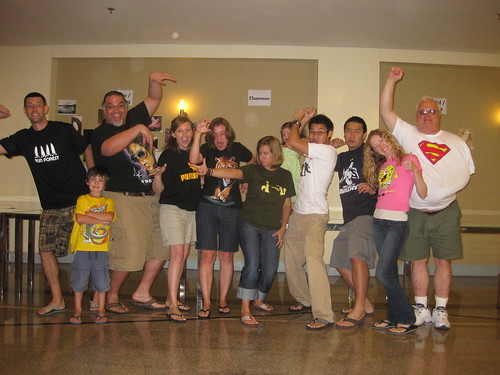
 For an explanation, head on over to Wu’s blog! (And no, spring has not sprung up here…these pictures are from the wonderful days of no long underwear in Thailand.)
Updated on August 4, 2011
Food for thought
A fundamental mistake in the Western body today is that it takes as its basic goal to get as many people as possible ready to die and go to heaven. It aims to get people into heaven rather than to get heaven into people. It creates groups of people who may be ready to die, but clearly are not ready to live. They rarely can get along with one another, much less those “outside.” Often their most intimate relations are tangles of reciprocal harm, coldness, and resentment. They have found ways of being “Christian” without being Christlike. As a result they actually fall short of getting as many people as possible ready to die, because the lives of the “converted” testify against the reality of “the life that is life indeed.” When we are counting up the results we also need to keep in mind the multitudes of people who will not be in heaven because they have never, to their knowledge, seen the reality of Christ in a living human being.
Dallas Willard, Renovation of the Heart
Updated on August 4, 2011
Necessity is the mother of all invention
There are some things that are much easier to do in China. For example, getting the heel of a shoe fixed or a broken zipper replaced is an easy matter. However, there are many tasks that for various reasons are trickier or more time consuming in China. Life here just sometimes requires a bit of creativity–especially in making items serve purposes they were not originally intended for. Below are a few of my favorite “inventions” that make my life easier:
The Mesh Garment bag
Not only is the mesh garment bag useful for washing your delicates, it also serves well as a container for Ziploc bags. As I’ve written before, Ziploc bags are worth their weight in gold over here (since we cannot purchase them in our city). Consequently, they get washed and reused many times. I got tired of a haphazard pile of Ziplocs in my drawer, so one day came up with this system. Two hooks attached to the back of a cabinet door and a garment bag was all it took for instant organization.
Garment bags have also revolutionized my system of washing lettuce. Washing, rinsing, and drying lettuce used to be such a pain that I rarely made salads. However, I then discovered that if you contained all of the lettuce within a garment bag, then put it in a tub of soapy water, and then rinsed it in the sink while still in the bag the process became much more manageable. The next step and creative re-purposing was my teammate Jennifer’s idea. When she first told me, I thought she was crazy. Then I tried it. And my life has never been the same. How do you dry the garment bag full of wet lettuce? Throw it in the spinner section of the washing machine. Our machines have two sections, a washing “bowl” and a spinning “bowl”. The spinner is much faster than machines in the states, getting most water out of clothes (or lettuce). Making salads has never been easier!
Plastic file holders
My kitchen is quite small, and I have a grand total of three drawers. Consequently, drawer space is at a premium and I had trouble fitting everything in. Then one day I figured out this plastic file holder was the perfect size to hold Saran wrap, aluminum foil, rolls of garbage bags, and Ziploc boxes (thanks to a generous father I have an entire box of Ziplocs…I lead a blessed life!).
Baby Strollers
At the start of every semester, we make books for our writing and oral classes based on the curriculum we’ve created. This means that we have to pick up 270 books from the copy center and transport them to the teaching buildings. Last year, Rachel and I discovered the perfect system: baby strollers. The “double-wide” from the Clements and the single stroller from the Wus are the perfect size for one set of books. You should see the stares we get pushing them through campus–people do a double take when they realize our precious cargo isn’t small children.
Sweater boots
These are my absolute favorite invention; however, I can’t take any credit for them. In fact, I was quite opposed to them at first sight. This winter as I was shopping for boots, I was frustrated when the only ones I could find in my size had this tacky sweater material attached to them. The plainer boots I really wanted were just a tad bit small. However, I have since fallen in love with my sweater boots. The extra layer of warmth on my legs is the perfect solution to the frigid weather we have here. (And lest you think I’ve lost all fashion sense since moving to China, the sweater remains quite hidden under my pants–although I’m quite sure the original intention of the boot maker was a loud and colorful statement.)
Updated on August 4, 2011
Unfortunate error of the day
Today in my writing class, we were reviewing the parts of the five paragraph essay. We were talking about the first sentence of the essay that grabs your attention (the hook) and the last sentence of the essay that brings everything to a close (the clincher). After filling out a worksheet, one of my students proudly stood up and read her answer to one of the questions:
“The clincher is the final statement of the essay that refers back to the hooker.”
And yes, I successfully stopped myself from laughing out loud. I’m pretty sure (at least I hope) I was the only one in the room amused by that error.
Updated on August 4, 2011
“Springing” Forward
By Sunday morning, almost all of the snow, slush, ice, and coal-dust-coated frozen substances had melted away. We were seeing pavement for the first time in months. While we weren’t changing time with the rest of the world (China doesn’t do the whole fall back and spring forward ritual), it appeared we were making bold strides toward spring.
 This is what the road looked like as I walked to class this morning. It started snowing Sunday afternoon. And it just kept coming. And coming. And coming. Piling up into what is one of the biggest snows I’ve seen in this (usually) dry frozen tundra.
 Don’t get me wrong, it is beautiful. But to be honest, I was less concerned with capturing its beauty than documenting its presence.
 It was my first day back to class in a week. I didn’t have time to putz around looking for the perfect shot. I was in a hurry to make copies before class. I had planned on making the copies Sunday. But then it started snowing…and I wasn’t about to go out in that unless I absolutely had to.
On an entirely different note, I have a new favorite Chinese word. You see, every time there’s a new invention, the Chinese don’t create a new character. Rather, they combine already existing characters to form the new word. The resulting literal translations of object names are quite descriptive and often amusing. Today in one of my classes I learned the word for trampoline, and it just made me giggle . ??? (bèng bèng chuáng). Literal translation? Jump Jump Bed. If that doesn’t bring a smile to your face, I don’t know what will.
Updated on August 4, 2011
The Quick Fix
We are a culture of quick fixes (and short attention spans…do your best to stick with me on this somewhat lengthy reflection). Speed and convenience are seen as suitable markers of progress. We thrive on fast cars, fast food, fast internet, and fast entertainment. If we want something, we want it now.
What I often fail to realize is how much this cultural obsession with speed affects the requests I lay before the Father—and my expectations as to the fulfillment of those requests. Take this past week for example: I went to bed last Monday night with swollen throat and high fever and my request was “heal me”. I wanted to be able to wake up Tuesday morning feeling miraculously better so that I could go about my oh-so-important business. Because heaven knows, the world just stops spinning if I’m not there to hold it up. I had classes to teach, and appointments with students. But guess what, the world kept turning without me, the classes will be made up this week, and my presence is not ultimately vital to the well being of this city.
But (as usual), I digress. The simple fact is that with my quick fix mentality and requests, I often fail to see the miraculous ways in which the Father very patiently and actively is answering me. I fail to see his activity in the fact that my body’s immune system knows how to attack the infection within me, in my body’s initiation (apart from any mental command of my own) of the coughing reflex to clear out the junk in my lungs, and in my body’s massive production of snot to clear out all the nasty little bugs in me. From the prior description, you can see I failed to follow the family path down the biological sciences. Should I have followed that path I might have been able to give a much more profound and detailed description of the workings of our body. Sadly, you will have to be content with my elementary understanding of biology.
However, the miracles become even more breath taking when you consider our requests in regard to people. Often when I petition for others I expect the small, instantaneous, surface level miracle. I forget that the greatest miracle is not that our Father works as a grand puppet master, forcibly moving beings at his whim and fancy—the miracle is that He takes the pain-stakingly long and arduous path of working in flesh. Of molding, calling, breaking, changing, and sculpting until that flesh is suited to His will and calling. And so His “Yes” to our requests can take days, weeks, months, years, decades to be completely fulfilled. But as they come to fruition, would we but have eyes open to see more than the quick fix, we would stand in awestruck wonder at the long-suffering, miracle-working, answering One we serve. The One who didn’t send a savior marching in on clouds of glory for the quick fix, but as a fetus slowly growing in a womb, slowly learning to walk and talk, slowly marching towards calvary.
Updated on August 4, 2011
Community
Things I love about my team:
- They bring me dinner when I’m sick.
- They give me drugs when I’m sick.
- They go out and buy tissues for me when I’m sick.
- They cover an already re-scheduled make-up class so I don’t have to re-schedule it again when I’m sick.
- They come by to check on me even when I’m un-showered lying next to a pile of used tissues.
- They kill roaches and other creepy crawlers I’m frightened of…and clean up the mess.
- They come armed with duct tape to fix a broken lamp.
- They know enough about my history, and everyone else’s history, to make a joke out of just about anything.
- I’m entirely comfortable showing up to a team meeting in pajamas, with no make-up, a red nose, and a box of tissues.
- They go out in the ice and the cold to pick up KFC for dinner for everybody.
- They throw awesome (make-up) birthday parties.


I’ve been down and out this week with a nasty bug. I can’t say it was an enjoyable week, but it was a week that made me very thankful for my team. I’m fever free for the first day in awhile, and trying to sort through what lies ahead of me this week. Some classes I’ve seen twice already. Some I haven’t even seen once. And I thought the whole “Saturday is Monday” set-up was confusing… Let’s just say there’s a pretty good chance I show up and start teaching the wrong lesson sometime this week.
Updated on August 4, 2011
Pruning
Thursday morning I headed out of my door with a skip in my step. I was finally headed back to the classroom and I was certain there was nothing that could get me down. Then I walked out of my building. What I saw didn’t ruin my mood, but it did cause a frown to pass across my face. Sometime while I was enjoying my last full day in pajama pants someone had been very busy out front of our apartment buildings. What two days before had been sturdy little trees boasting numerous (albeit bare) branches had now become these glorified sticks.
The Chinese approach to spring cleaning and pruning at times mystifies me. Their measures often appear quite drastic and severe. However, there’s a fairly good chance they know a bit more about tending plants than I do. Three years ago, these very same trees were planted in a similar very stick-like state outside our building.
As foreign teachers, we mocked the sticks mercilessly. What were the planters thinking? It would take years before these sticks could resemble anything close to a tree! Needless to say, we all ate our words when we returned to campus in August to find these:
And the following spring, our little sticks were bursting forth with flowers. Maybe those Chinese gardeners did know what they were doing after all.
This history of our sticks passed through my mind as I headed off to class. There’s something about pruning that we seem to naturally despise. The process, after all, is not in the least bit beautiful. In fact, it is often the very parts that appear to be teeming with life that get cut off in the process of pruning. What’s left behind ends up looking more dead than alive. In fact, the naive passerby may scoff and doubt that life, never mind abundant life, could ever come from that.
How tempting is it to avoid pruning? To the outside world, this avoidance is one way to keep up the appearance of life and fruit. We may continue to flower, but we’ll never grow to our full potential. We were made to bear fruit abundantly, and the simple fact is that such bearing requires much pruning. Pruning that at times may by all appearances seem to be draining the life right from us. But should we have patience, life–abundant life–awaits us.
I am the true vine, and my Father is the gardener. Every branch that bears fruit he prunes so that it will be even more fruitful. No branch can bear fruit by itself; it must remain in the vine. If you remain in me and I in you, you will bear much fruit, apart from me you can do nothing. This is to my Father’s glory, that you bear much fruit.

Recent Comments